A Complying Development Certificate (CDC) is a fast-track approval issued by a private certifier when a project meets every pre-set planning rule, and it must be determined within 20 days. A Development Application (DA) is assessed by your local council on its merits, usually takes two to three months, and allows designs a CDC cannot.
Unless your block strictly states it, you will most likely meet this decision a few weeks into your design. At first it sounds like paperwork; two acronyms, a form to fill in, something your architect will take care of. It is rather more than that. The approval pathway you take defines how far you can push your design vision, decides how long you will need to wait for approval and, on some blocks, what you are allowed to build at all.
In most cases you will not have to choose – your block and/or your design vision will decide it for you. Your architect will be there to help define which approval pathway you take.
What is a Complying Development Certificate?
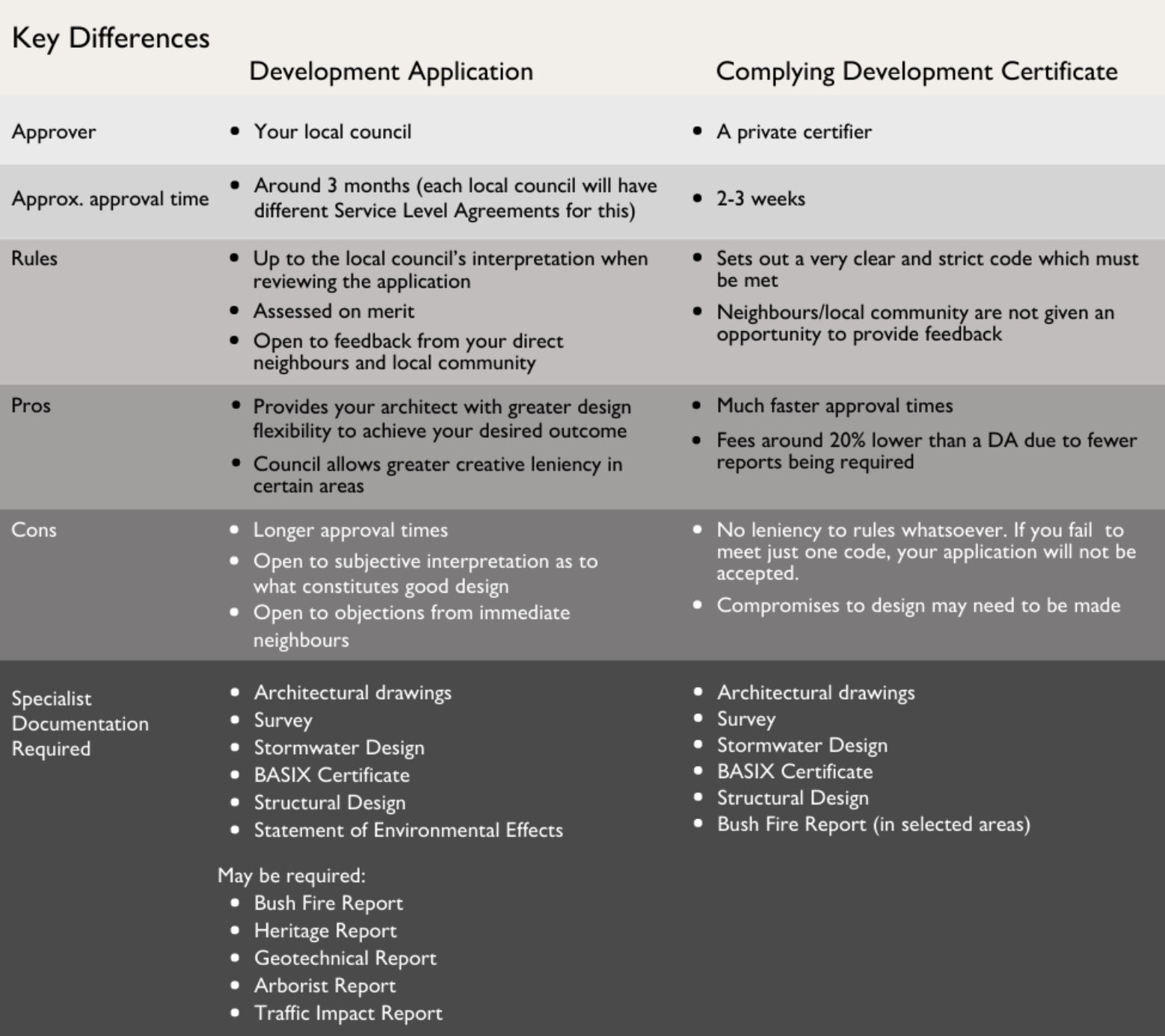
A CDC is a combined planning and construction approval. It exists so that low impact developments can bypass a local council’s approval process (which can, at times, be onerous), and hence tends to be much more cost effective and quicker than a DA.
A CDC is assessed by a private certifier (rather than your local council) and is judged against a set development standard of rules which sit in the State Environmental Planning Policy (Exempt and Complying Development Codes) 2008, otherwise known as ‘the Codes SEPP’. This Code holds NSW statewide planning control, meaning they remain the same for a home in Freshwater as they do for a home in Randwick. If you hire a private certifier to issue a CDC, your local council must still be informed, although they have no say in the approval process – and neither do your neighbours.
There are strict, non-negotiable rules about the size and shape of your block, how tall you can build, and how close you can come to each boundary. Your architect will check your site against them early, because the answer to this shapes what design can be drawn.
The quantity of documentation for a CDC submission is not as onerous as what is required for most DA’s. Your private certifier will assess and approve your design if it complies with the Code. This means if just one aspect of your design does not meet the specified Code, your application will be rejected – there is no leniency or flexibility to this. For example, your site may be excluded from being able to do a CDC due to its:
- Zoning
- Slope gradient
- Proximity to environmentally sensitive areas
- Heritage status
- Development type, or
- Simple non-compliance with other elements outlined in the Code
This lack of flexibility often means you need to make compromises with your design to satisfy Code requirements, as opposed to councils granting leniency in a DA via judging a design on its merit. This may restrict the parameters through which you can achieve your design vision. If your project satisfies every one of the required Codes, a registered certifier can issue your approval without any assessment of design or local environment merit or impact.
What is a Development Application?
A DA asks your local council for permission to build a proposed design. The town planner at council subjectively assesses that design on its merits. They read your proposal against the Local Environmental Plan (LEP) and Development Control Plan (DCP) planning controls that apply to your suburb, against the matters set out in section 4.15 of the Environmental Planning and Assessment Act 1979, and against anything your neighbours may have have to say about it.
That judgement is what makes a DA slower. It is also what makes it worth having. A planner can accept a variation when the reasoning behind it is sound, and can approve a design that steps outside a number because the result is better for it. A certifier has no such latitude, which is why most carefully designed homes on difficult Sydney blocks end up at council.
At the planning application lodgement stage, council will ensure you’ve supplied the correct documentation, request any additional required information, notify neighbours and the community (where applicable), and engage internal or external expert referrals. You will also be allocated an assessment officer as a main point of contact for your DA.
Pro Tip: Preparing your plans for DA lodgement can be a complicated and lengthy process, with lots of back and forward with your local council until they have all they need from both your Architect and other Consultants. Always check if your Architect has included DA lodgement as a part of their Fee Proposal as this will save you hours of administrative work and follow up.
The assessment stage will follow directly, where council will review all documentation within your application and assess each element against their LEP and DCP. There is typically a margin of leniency incorporated into council’s development controls, and any specific elements of your design that fall outside of these parameters will be assessed on merit. This level of flexibility is the key advantage of taking the DA approval pathway versus CDC.
At the determination (or decision) stage, there can be three outcomes:
- Development Consent – your plans are approved, either as is or with conditions
- DA Refusal – with reasons outlined, or
- Deferred Commencement Consent – that is, a consent not operating until one or more other important matters are resolved. This is not a common outcome.
After consent has been granted the final stage is gaining a Construction Certificate, which must be received before any building commences.
The entire DA process takes anywhere from three months on average. Your local council should have a Service Level Agreement (SLA) noted somewhere on their website which states how long their particular planning approval process usually takes. In general, the clearer and more detailed your initial documentation is, and the more pre-lodgement engagement you have from your neighbours, the faster the whole process will be. If council needs to “stop the clock” to request and await further information, or if changes need to be made to your plans, additional time will be added to the approval process. This is another reason why getting your architect to do your DA lodgement and management is the best way forward.
So, which approval process should you choose?
Keeping an open mind at the start of your design journey is key to ensuring the best outcome for your project, as opposed to designing to a set of pre-determined rules established by your local council or the CDC guidelines. While there is obvious appeal in getting your renovation or new build approved quickly, the ultimate goal should focus on achieving your vision.
After agreeing on initial design concepts, your architect will be able to advise whether a DA or CDC is the most suitable approval avenue for your project.
- This decision will depend on:
- the local council you are building in
- the design of the home you are building / renovating
- the block or land you are developing, and
- the time frame you’re looking to build in.
In general, if you have a straightforward build or renovation that can easily meet CDC guidelines, and time is of the essence, approval via CDC is quicker and slightly more cost effective.
If, on the other hand, your dream home falls outside the strict CDC guidelines, you are renovating under heritage restrictions, or if your home is in an environmentally sensitive area, submitting a DA through council may be your only option. While the DA process does take longer, it can be a relatively smooth process if you have detailed, professional documentation and are not looking to overstep the somewhat flexible guidelines of a council’s development controls.
Who can help with your application submission?
Application submissions can be daunting, which is why MILEHAM manages this process on behalf of our clients. We have completed many DA and CDC applications and have an excellent track record for achieving planning approval first time round.
We complete all the necessary paperwork and architectural documentation, liaise with all the necessary consultants for the required reports, and handle any queries or additional information requests from your local council or private certifier which may come back regarding your application. We also look after procurement of the Construction Certificate for your project so you may begin your build.
Further Reading
There are some developments which are exempt from DA or CDC approval. You can view the legislation and provisions via the NSW Government website.
Your local council website will have a section dedicated to local developments. This section will contain information on the DA process and the documentation required for your area.
Still unsure whether your home renovation or new home build is best suited for a DA or a CDC? Get in contact with MILEHAM today and discover the best approval pathway for your project.